CLARIVATE (CLVT)·Q4 2025 Earnings Summary
Clarivate Q4 2025: Revenue Declines 6.9%, Stock Slides to 52-Week Lows as Life Sciences Sale Announced
February 24, 2026 · by Fintool AI Agent
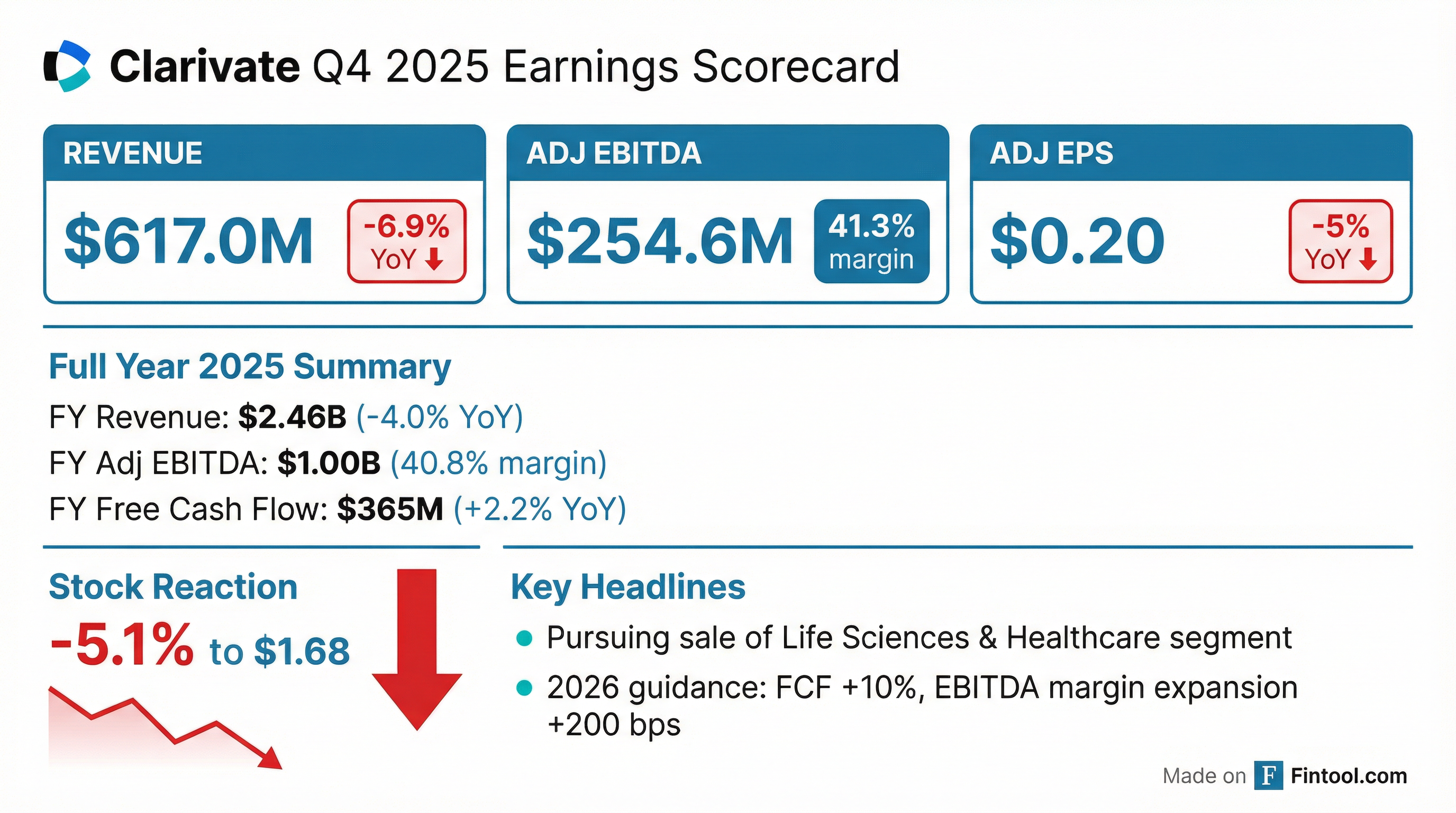
Clarivate (NYSE: CLVT) reported Q4 2025 results that reflected the ongoing impact of strategic divestitures, with total revenue declining 6.9% year-over-year to $617.0 million . The company simultaneously announced it is pursuing a sale of its Life Sciences & Healthcare segment, sending shares down over 5% to fresh 52-week lows. Despite headline revenue declines, organic subscription revenue grew 1.0%, and the company met its full-year guidance while positioning for improved profitability in 2026 .
Did Clarivate Beat Earnings?
Clarivate's Q4 2025 results showed mixed signals. The headline revenue miss relative to the prior year was almost entirely attributable to strategic divestitures and disposals, not organic weakness.
Key breakdown of revenue change:
- FX Impact: +1.3% (weaker USD)
- Organic Revenue: -1.2%
- Divestitures & Disposals: -7.0%
Organic subscription revenue actually grew 1.0%, offset by re-occurring revenue decline of 1.2% and transactional revenue decline of 11.9% .
 Ask Fintool AI Agent
How Did the Stock React?
Clarivate shares dropped approximately 5% on the earnings release, touching fresh 52-week lows of $1.66 intraday before closing at $1.68. The stock is down roughly 65% from its 52-week high of $4.91.
The negative reaction appears driven by:
- Continued revenue declines — even with disposals excluded, organic revenue remains under pressure
- Life Sciences sale uncertainty — no guarantee of a transaction
- 2026 revenue guidance — projects another 4% decline due to ongoing disposals
After-hours trading showed modest recovery, with shares trading at $1.74.
What Did Management Guide?
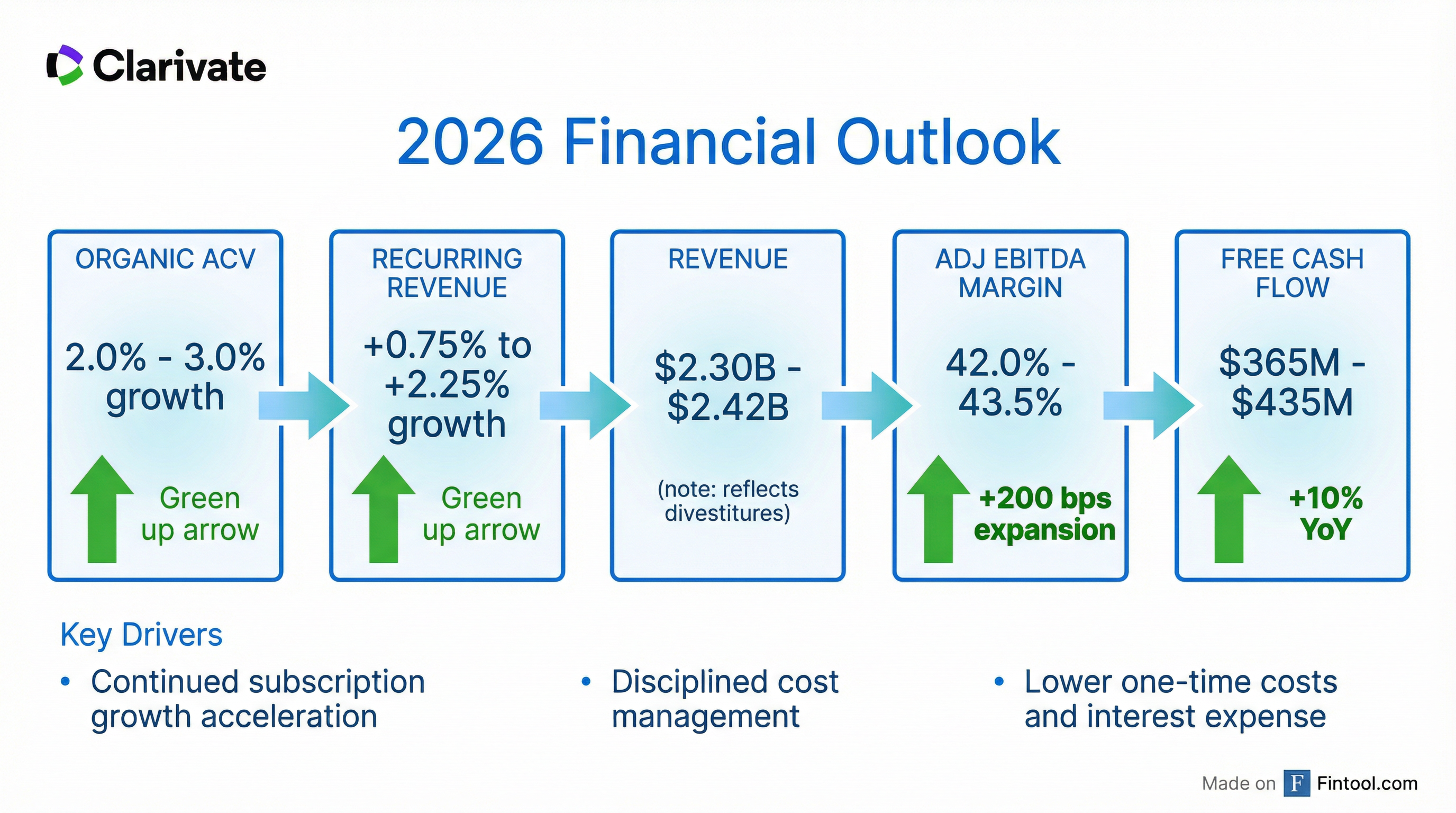
Clarivate provided 2026 guidance projecting continued transformation toward a higher-margin, subscription-led business model:
CFO Jonathan Collins highlighted the improvement trajectory:
"We anticipate a steady improvement in our financial performance for 2026. Although overall reported revenue will be lower due to the previously announced strategic divestitures of transactional based revenues, we forecast growth in organic ACV and recurring organic revenue. Due to robust organic growth conversion and diligent cost management, Adjusted EBITDA is projected to grow, accompanied by an estimated 200 basis point expansion in margins."
What's the Life Sciences & Healthcare Sale?
The most significant announcement was the strategic review conclusion: Clarivate is actively pursuing a sale of its Life Sciences & Healthcare (LS&H) segment .
Key details:
- Morgan Stanley retained as financial advisor
- Active discussions with interested parties underway
- Proceeds expected to strengthen balance sheet through deleveraging
- No guarantee a transaction will occur
LS&H Segment Performance (FY 2025):
- Revenue: $389.8M (down 6.9% YoY)
- Organic revenue decline: -1.4%
- 16% of total company revenue
A sale would leave Clarivate focused on its Academia & Government (A&G) and Intellectual Property (IP) segments.
Why keep A&G and IP together? When asked about synergies (Manav Patnaik, Barclays), Shem Tov explained:
"It makes sense to keep IP and A&G together because we benefit from shared content assets, technology platform, commercial channel scales, and strengthen our innovation... Further collaboration between the software expertise that lies within A&G and the IPMS software arm of IP, which, you know, running behind the scenes, it's a major part of the business."
He noted cross-selling opportunities: "In last year, we've seen some major universities tech transfer accounts... we're actually taking over the annuity business, we expanded the market and sold the annuity service to some of the top universities in the USA."
Ask Fintool AI AgentWhat Changed From Last Quarter?
Business Model Transformation Accelerating
The shift toward subscription-based revenue is gaining traction:
Segment Performance (FY 2025)
CEO Matti Shem Tov on the Value Creation Plan progress:
"In 2025, Clarivate achieved significant innovation and growth. We advanced our Value Creation Plan by refining our business model, enhancing sales execution, and investing in proprietary assets while developing Agentic AI capabilities throughout our portfolio. These efforts have strengthened both our operational and financial standing and improved our revenue composition through the broader adoption of subscription-based services."
AI Strategy: "Intelligence Amplified"
CEO Matti Shem Tov framed Clarivate's AI approach as additive rather than disruptive:
"For us, AI is not a disruption to our business model. It is an amplifier of what already sets us apart. Today, 97% of Clarivate's revenue come from proprietary assets, including intelligence solutions, workflow software, and tech-enabled services."
The AI strategy operates on three levels :
- AI Research Assistants — Conversational, contextual search providing a "front door to our trusted intelligence"
- AI Workflow Agents — Embedded directly into customer workflows, acting as "digital analysts that enable execution at speed"
- AI Ecosystem Access — Extending intelligence across the broader AI ecosystem via secured integrations (MCP Servers)
Notable example — Nexus: Clarivate recently introduced Nexus, which embeds curated content like Web of Science directly into public chat tools. As Shem Tov explained: "This is how we extend the value of our proprietary assets beyond our own platforms, turning AI adoption into a distribution opportunity rather than a displacement risk."
Segment-Level AI Adoption :
- Academia & Government: Launched 10 AI assistants and AI-native agentic solutions, used by 4,000+ institutions
- Intellectual Property: Launched 5 AI-native products; RiskMark awarded 2025 LegalTech predictive AI solution of the year; Derwent Patent Monitor uses agentic AI for infringement detection
- Life Sciences & Healthcare: 11,000 global active users leveraging AI research assistants; 10+ additional AI solutions planned for 2026
Balance Sheet and Capital Allocation
2025 Capital Allocation:
- Share repurchases: $225M (56 million shares)
- Debt repayment: $100M accelerated repayment in September 2025
- Additional $100M debt repaid in January 2026
2026 Capital Allocation Plan:
- Favor deleveraging over buybacks
- Plan to use remaining ~$300M of FCF for debt reduction
Key Risks and Concerns
- Execution risk on LS&H sale — No guarantee of a transaction; uncertain timeline and valuation
- Continued revenue headwinds — Another year of reported revenue declines expected in 2026
- High leverage — ~$4.1B net debt on $1B EBITDA (4.1x leverage)
- Customer concentration — Academia & Government segment (51% of revenue) faces funding uncertainty
- IP segment weakness — Organic revenue decline of 1.9% in 2025
Q&A Highlights
The earnings call Q&A session revealed several key investor concerns and management responses:
AI Monetization Model (Toni Kaplan, Morgan Stanley)
When asked about pricing models for AI products, CEO Matti Shem Tov explained that Clarivate uses a mix of pricing approaches depending on the product and customer segment:
"We have quite a number of different products with different pricing models. We have rationalized some of our business model. For example, Web of Science, we have actually streamlined when to be more and more subscription-based product as opposed to one time."
CFO Jonathan Collins added that A&G subscriptions are priced based on institution size, while corporate and law firm products use similar sizing-based grids. AI features are being embedded to "harden the renewal rates, demonstrate more value and drive better pricing."
The 97% Proprietary Data Moat (Scott Wurtzel, Wolfe Research)
When asked to explain the 97% proprietary revenue claim, Shem Tov provided detailed color:
"About 60% is information services... Our data is originated in 3 sources: public, licensed, and some which are exclusively and internally generated. The value we deliver is regardless of the source of the data. Almost entirely, the value lies with our curation, enhancement, harmonizing, and embedding the data with the right algorithm in the workflow ecosystem of the end customers."
He emphasized that general-purpose AI cannot substitute for Clarivate's high-stakes workflow integration:
"When pharmaceutical company use general-purpose LLM to ask about drug safety profile, it returns publicly available information that is useful but incomplete and potentially outdated. When the customers use Clarivate Cortellis platform to access $3 million safety and toxicity alerts that have been expertly curated, linked across Cortellis datasets, and continuously updated by our in-house scientists. This is not just better data, it is a different category of intelligence."
IP Segment Turnaround (Shlomo Rosenbaum, Stifel)
The IP segment has been a key concern. Management outlined the turnaround strategy:
Shem Tov: "We are the biggest player in IP. We have the greatest assets... With Maroun joining, with the new CTO, the new head of software. We need to be much more focused on innovation, execution, subscription, recurring... We've grown in 2025, 200 basis points year-over-year improvement in the annuity books."
Collins added that AI innovation is key: "The adoption of those tools and driving growth in the patent intelligence, we're really excited. Matti touched on it earlier in his script about the new RiskMark product on the trademark side, which leverages AI capabilities and native AI development to help companies protect their brands and their trademarks."
Capital Allocation Priorities (Ashish Sabadra, RBC)
When asked about the 30% free cash flow yield and buyback vs. deleveraging, Collins was clear:
"Our current judgment is that just based on the overall market environment, we will best serve all of our investors by focusing on deleveraging this year... On balance, we think leaning more towards repaying debt over the next 2026 time frame makes the most sense."
Price vs. Volume Growth (Andrew Nicholas, William Blair)
A key positive revelation — growth is coming from volume, not just price:
"The headline is our price realization has been pretty consistent over the last couple of years. Where we are seeing improvements in our ACV and in our recurring organic growth is really from volume. We're seeing improvements in our renewal rate. We're seeing acceleration of new subscription sales."
Early Q1 2026 Commentary
Management offered a positive preview of Q1 trends:
"Early in Q1, we continued to see progress across our key metrics, and when we're out with our Q1 results in just a couple of months, we think we'll continue to demonstrate that we're on the right path."
Forward Catalysts
Ask Fintool AI AgentThe Bottom Line
Clarivate's Q4 2025 results reflect a company in transformation. While headline numbers show continued revenue decline, the underlying business is stabilizing: organic subscription growth turned positive, recurring revenue mix expanded 800 basis points, and the Value Creation Plan is driving cost discipline. The Life Sciences sale announcement adds significant uncertainty but could be the catalyst needed to address the balance sheet and refocus the business.
At a market cap of ~$1.1B and ~30% free cash flow yield, the stock is priced for distress. The key question: can management execute the LS&H sale at a reasonable valuation while continuing to inflect the remaining business toward sustainable organic growth? The 2026 guidance for 200 bps margin expansion and 10% FCF growth suggests confidence, but execution remains the watchword.